What Are the Best Pesticide Storage Solutions from China?
Choosing the best pesticide storage solutions from China requires more than comparing cabinet prices. It requires evidence, traceability, and practical risk control. FAO’s Pesticides Use and Trade 1990–2022 report recorded approximately 3.70 million tonnes of pesticide use globally in 2022. That volume highlights a simple reality: storage failures can affect workers, facilities, soil, and water.
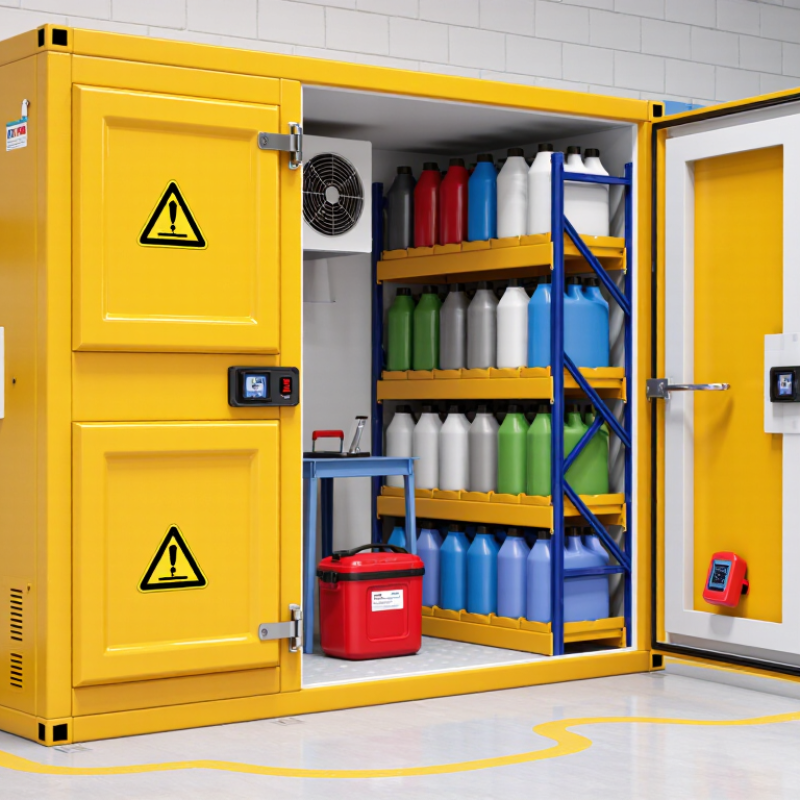
Effective pesticide storage should combine lockable steel cabinets, chemical-resistant coatings, secondary containment, and controlled ventilation. Shelving must remain stable under heavy containers. Floors should be smooth, sealed, and easy to clean. Clear labels matter. So do temperature records, spill kits, and separated areas for incompatible products. Chinese manufacturers can offer customized cabinets, insulated storage rooms, and modular warehouses. Buyers should request material certificates, factory inspection records, fire-test documents, and relevant GB standard references. GB 15603 provides general guidance for chemical storage, but product-specific requirements still need careful review.
No cabinet is perfect. Fred Whitford, a pesticide safety specialist at Purdue University, repeatedly teaches, “The label is the law.” That principle should guide every purchasing decision. The label determines segregation, ventilation, emergency measures, and handling limits. A low-cost cabinet may look efficient, yet weak hinges or poor seals can create expensive problems later. Buyers should inspect welds, door locks, drainage details, and corrosion resistance before ordering. They should also confirm after-sales support and replacement parts. The best pesticide storage solution from China is not merely attractive or inexpensive. It is documented, maintainable, and suitable for the actual climate, inventory, and daily workflow. Reflection remains necessary. A technically compliant design can still fail through careless housekeeping.
Classify Pesticides Under China’s GB 12268 and GHS Hazard Codes
China’s pesticide storage begins with correct classification, not cabinet selection. GB 12268 identifies dangerous goods for transport and assigns UN numbers, while China’s GB 30000 series applies GHS hazard classifications. A pesticide may carry acute toxicity, flammability, corrosion, or aquatic-environment hazards. Its SDS should confirm every category before storage planning.
FAOSTAT’s Pesticides Use and Trade 1990–2022 recorded about 3.70 million tonnes of pesticide active ingredients used worldwide in 2022. This volume shows why small classification errors can create large warehouse risks. A Chinese storage facility should separate incompatible classes, control ignition sources, and use sealed secondary containment. For example, products with H300 or H310 require locked, access-controlled storage. H226 products need ventilation and ignition control. H410 products need spill protection that prevents drainage into soil or water.
Good practice includes steel cabinets, corrosion-resistant shelves, raised pallets, and visible Chinese hazard labels. GB 12268 transport status alone is not enough for warehouse design. Check the SDS, GHS pictograms, packing group, and local fire requirements together. The UNEP Global Chemicals Outlook II warned that chemical production and use could expand sharply by 2030, increasing pressure on storage systems. Yet, one weakness remains: many facilities treat classification as paperwork. It should guide shelf spacing, ventilation, spill kits, and emergency drills. Consult a qualified safety professional when classifications conflict.
What Are the Best Pesticide Storage Solutions from China?
Classify Pesticides Under China’s GB 12268 and GHS Hazard Codes
GHS Acute Oral Toxicity Categories
The chart shows the upper acute oral toxicity threshold for each GHS category, expressed as mg/kg body weight.
Lower thresholds indicate greater acute toxicity and generally require stronger access control, segregation,
inventory management, and emergency-response measures. Actual pesticide classification must be confirmed from
the product’s safety data and applicable Chinese regulatory entries.
GB 12268 Class 3
Flammable liquids. Use approved flammable-liquid cabinets, ignition-source control, ventilation, and grounding where applicable.
GB 12268 Class 6.1
Toxic substances. Keep locked, restrict access, maintain clear labels, and provide spill-response and personal-protection equipment.
GB 12268 Class 8
Corrosive substances. Use compatible shelving, secondary containment, and separation from incompatible materials.
GB 12268 Class 9
Environmentally hazardous substances. Prevent drainage releases with bunded floors, sealed containers, and controlled spill collection.
Practical storage principle:
Use the GHS label and SDS to identify health and environmental hazards, then check GB 12268 for the applicable dangerous-goods transport and storage classification. Store pesticides by compatibility and hazard class rather than by supplier or brand.
Design Secondary Containment to the 110% Largest-Container Benchmark
Choosing pesticide storage solutions from China should begin with containment, not appearance. A reliable design uses a secondary sump, tray, or bund that holds at least 110% of the largest container. For a 200-liter drum, the minimum working capacity is 220 liters. That figure is a baseline, not a universal legal guarantee. Local requirements, fire controls, and site conditions still need professional review.
Material selection matters. High-density polyethylene resists many corrosive liquids, while coated steel can support heavier loads. Ask manufacturers for wall thickness, load ratings, seam details, and leak-test records. Custom dimensions are useful when storage rooms have narrow doors or uneven floors. Keep the containment floor level and easy to inspect. Avoid drain openings unless an approved collection system is designed.
One detail is easy to miss. Shelves can reduce usable capacity when they sit inside the bund. I have seen a 220-liter tray become ineffective after stored equipment displaced much of its volume. That assumption can fail. Measure the actual internal space, not the product label alone. Add visible level markings, compatible absorbent materials, and a routine inspection log. Check for cracks, swelling, blocked access, and damaged pallets. A well-made Chinese solution should include traceable materials and clear installation guidance. Still, documentation must match the delivered product. Inspect it before use, and record any defects immediately.
What Are the Best Pesticide Storage Solutions from China? – Design Secondary Containment to the 110% Largest-Container Benchmark
| Storage Solution |
Typical Configuration |
Approx. External Dimensions
(L × W × H) |
Largest Container |
110% Required Capacity |
Usable Containment Capacity |
Typical Construction |
Recommended Application |
Design and Safety Features |
| 2-Drum Spill Pallet |
Two standard 200 L drums stored on a removable grate |
1,300 × 1,300 × 150 mm |
200 L |
220 L |
Approximately 240 L |
Rotomolded polyethylene with molded sump |
Small pesticide stores, decanting areas, and maintenance rooms |
Leak-resistant sump, forklift pockets, removable grate, and low access height |
| 4-Drum Spill Pallet |
Four 200 L drums arranged in a 2 × 2 layout |
1,300 × 1,300 × 150 mm |
200 L |
220 L |
Approximately 240 L |
High-density polyethylene with reinforced support ribs |
Routine storage of multiple liquid pesticide drums |
Raised grating keeps containers above spilled liquid; compatible with pallet trucks when specified |
| Drum Bund with Ramped Access |
Four 200 L drums inside a low-profile bund with an integrated ramp |
1,450 × 1,450 × 180 mm |
200 L |
220 L |
Approximately 300 L |
Welded polyethylene or coated steel with chemical-resistant liner |
Warehouse storage where drum handling equipment is frequently used |
Removable ramp, anti-slip grate, corner protection, and optional drain plug kept closed during storage |
| Single-IBC Containment Tray |
One 1,000 L intermediate bulk container positioned on a raised grid |
1,400 × 1,400 × 650 mm |
1,000 L |
1,100 L |
Approximately 1,150 L |
Rotomolded polyethylene or fabricated polypropylene |
Bulk pesticide concentrate and liquid formulation storage |
Full-footprint support, high sidewalls, visual leak inspection, and compatibility checks for the formulation |
| Four-IBC Modular Bund |
Four 1,000 L IBCs arranged in a 2 × 2 storage bay |
2,600 × 2,600 × 350 mm |
1,000 L |
1,100 L |
Approximately 1,250 L |
Interlocking polyethylene modules with reinforced grating |
Higher-volume storage rooms and segregated pesticide inventory zones |
Modular expansion, forklift access, removable grates, and separate chemical segregation bays |
| Custom Room-Level Bund |
Impermeable floor bund surrounding drums, IBCs, or process equipment |
Designed to room layout; typical curb height 150–300 mm |
Based on the largest container in the room |
110% of the largest container |
Capacity verified by internal volume calculation |
Reinforced concrete or steel floor with chemical-resistant coating |
Dedicated pesticide warehouses, mixing rooms, and transfer areas |
Sealed penetrations, protected drainage, controlled entry, non-slip finish, and documented capacity calculation |
|
Design note: The 110% benchmark is calculated as 1.10 × the capacity of the largest single container within the containment area. For example, a 1,000 L IBC requires at least 1,100 L of usable secondary containment capacity. Actual selection should also verify chemical compatibility, structural loading, fire protection, ventilation, drainage control, local environmental requirements, and the applicable regulations at the installation site.
|
Provide at Least 6 Air Changes per Hour for Toxic Chemical Storage
What Are the Best Pesticide Storage Solutions from China?
Toxic chemical storage requires controlled airflow, not simply an open window. A practical benchmark is at least six air changes per hour, as referenced in ASHRAE HVAC applications guidance for hazardous chemical areas. For a 30 m³ room, this equals 180 m³ of exhaust air per hour. The calculation is simple. The installation is not.
A reliable Chinese storage solution should use continuous mechanical exhaust, corrosion-resistant ducting, and a fan positioned outside the contaminated airstream. The room should remain slightly negative compared with adjacent spaces. Fresh replacement air must enter safely, or the exhaust rate may fall below six changes per hour. The U.S. EPA Pesticide Worker Protection Standard emphasizes reducing inhalation and dermal exposure through proper handling, training, and protective controls. Ventilation supports these controls, but cannot replace them.
Shelving should be non-absorbent, stable, and separated by chemical compatibility. Secondary containment helps limit leaks from damaged containers. Install airflow indicators, high-temperature alarms, emergency lighting, and clearly accessible safety data sheets. NFPA 30 guidance also highlights ignition control and appropriate separation where flammable liquids are present. Six air changes are a baseline, not a magic number. Dust, heat, blocked grilles, and poor maintenance can weaken performance. A commissioning test should measure actual airflow after installation. That step is sometimes skipped. It should not be.
Control Temperature and Humidity Within Each Product Label’s Limits
The best pesticide storage solutions from China should control temperature and humidity within each product label’s limits. A sealed, insulated room is useful, but insulation alone cannot correct poor ventilation or condensation. Choose modular storage rooms with calibrated sensors, dehumidifiers, filtered ventilation, and automatic alarms. Place sensors near doors, corners, and the highest shelves. These locations often experience hidden temperature changes.
FAO and WHO pesticide-management guidance recommends secure, dry, well-ventilated facilities with clear product identification and controlled access. FAO’s 2019 State of Food and Agriculture reported that 14% of food is lost between harvest and retail. Reliable agricultural inputs support this supply chain, but careless storage can reduce product quality before use. Keep every container on spill pallets, away from direct sunlight and floor moisture. Separate incompatible materials according to the label and safety data sheet.
Chinese suppliers can provide insulated panels, humidity-control systems, secondary containment, and cloud-based data logging. Ask for sensor calibration records, alarm-test results, and documented temperature mapping. A single wall thermometer is not enough. It may miss a hot upper shelf. Review the strictest label requirement before setting the controller. Do not assume one temperature suits every formulation. A neat room can still fail during a power outage, so emergency ventilation and backup monitoring deserve attention. I would also question any system that reports perfect stability without regular verification.