
What Is Ferric Sulfate Wastewater Treatment?
Ferric Sulfate Wastewater Treatment uses ferric sulfate to remove suspended solids, phosphorus, color, and some dissolved contaminants. When added to wastewater, ferric ions react with alkalinity and water. They form ferric hydroxide particles that attract smaller impurities. These particles join into visible flocs, which can settle in a clarifier or be captured by filtration.
The process often begins with controlled chemical dosing. Operators may adjust the dose after jar testing, because wastewater composition changes throughout the day. A sample may look clear in the morning, yet produce weak flocs after a storm. Mixing also matters. Rapid mixing spreads the chemical, while slower mixing helps fragile flocs grow. Poor timing can leave cloudy water and excessive chemical use.
Ferric sulfate can support reliable treatment, but it is not a universal fix. It may lower pH, consume alkalinity, and increase sludge production. The sludge can appear dense, reddish-brown, and difficult to dewater. Residual iron should also be monitored, especially when treated water enters sensitive receiving environments. Experienced plant teams verify performance through turbidity, phosphorus, pH, alkalinity, and sludge tests. They should also follow supplier guidance and local discharge requirements.
The chemistry is practical. The results are not always predictable. Temperature, organic matter, and competing ions can change treatment performance. A careful design therefore combines laboratory testing, field observation, and routine process control. This balanced approach makes ferric sulfate treatment more dependable, while acknowledging its operating limits.
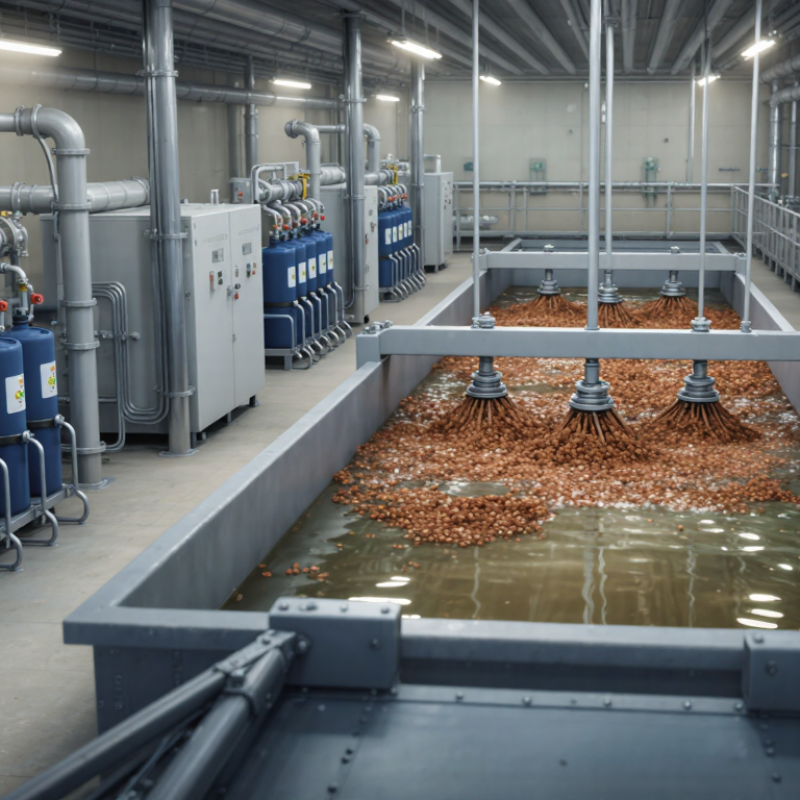
What Is Ferric Sulfate Wastewater Treatment?
Ferric sulfate wastewater treatment uses ferric sulfate as a chemical coagulant. In water, it hydrolyzes and forms positively charged iron compounds. These compounds attract suspended particles, phosphate, and some dissolved pollutants. The particles join into heavier flocs, which can settle or separate through filtration.
Operators usually add ferric sulfate in a rapid-mixing tank. Slow mixing then helps larger flocs develop. A settling basin removes the flocs as chemical sludge. Treatment performance depends on pH, alkalinity, temperature, and pollutant levels. A jar test is practical before full-scale dosing. It shows whether the selected dose creates dense flocs or only weak, floating particles.
Small adjustments matter. Too little chemical leaves cloudy water and excess phosphate. Too much can increase sludge, lower pH, and raise dissolved iron. Regular checks should include turbidity, pH, phosphate, and residual iron. Operators should also inspect sludge texture, not only laboratory numbers. Real wastewater changes during storms, production shifts, and cleaning cycles. Ferric sulfate is effective, but it is not a magic powder. Poor mixing can ruin a sound treatment plan. Handling requires suitable protective equipment and controlled storage. A better design may still need biological treatment, filtration, or pH correction.
How Ferric Sulfate Removes Contaminants from Wastewater
What Is Ferric Sulfate Wastewater Treatment?
Ferric sulfate is an inorganic coagulant used to remove suspended solids, phosphorus, and some organic matter from wastewater. When added to water, it reacts with alkalinity and forms ferric hydroxide flocs. These sticky particles capture fine solids as they settle. The process resembles snow gathering dust in a basin.
Ferric sulfate also binds dissolved phosphate into insoluble iron phosphate compounds. According to the U.S. Environmental Protection Agency’s Nutrient Control Design Manual, chemical phosphorus removal commonly achieves about 80–95% reduction when dosing, mixing, and settling are properly controlled. Actual performance varies. Wastewater temperature, pH, alkalinity, and influent strength can change the result.
Operators typically use rapid mixing for chemical dispersion, followed by gentle flocculation and clarification. A 2018 Water Environment Federation manual identifies chemical coagulation as a practical method for improving solids and phosphorus removal in treatment plants. Ferric sulfate may work across a broad pH range, but excessive dosing can increase sludge production and chemical costs. That trade-off is easy to underestimate.
A jar test remains essential. It shows whether the selected dose creates dense flocs or fragile particles that escape with the effluent. Ferric sulfate does not destroy every contaminant. It mainly transfers pollutants into sludge, which still requires controlled handling and further treatment. The chemistry works well, but it is not automatic.
Key Stages in the Ferric Sulfate Treatment Process
What Is Ferric Sulfate Wastewater Treatment?
Key Stages in the Ferric Sulfate Treatment Process
Ferric sulfate wastewater treatment uses an iron-based coagulant to remove suspended solids, phosphorus, color, and some dissolved metals. The process begins with wastewater testing. Operators check pH, turbidity, alkalinity, phosphorus, and flow changes. These results guide the chemical dose. A fixed dose rarely works well for every discharge.
Ferric sulfate is added in a rapid-mixing tank. Strong mixing spreads the chemical through the water within seconds. The iron reacts with impurities and forms small particles. pH matters here. If alkalinity is low, treatment may weaken, and the water can become more acidic. A jar test helps compare doses before full-scale operation. Even then, plant conditions may differ.
The water then enters a flocculation basin, where slower mixing joins the small particles into larger flocs. Gentle movement is important. Excessive mixing can break them apart. In a settling tank, the heavier flocs sink and create chemical sludge. Some facilities use dissolved air flotation when solids are light or oily. Filtration may follow to capture fine particles that escape clarification. Operators should inspect sludge blankets, filter pressure, and outlet turbidity each shift. Sludge handling also needs attention because poor dewatering can increase disposal costs. A jar test can look successful, yet the full system may perform differently. Careful records and repeated sampling expose those gaps.
What Is Ferric Sulfate Wastewater Treatment?
Key Stages in the Ferric Sulfate Treatment Process
Ferric sulfate treatment removes suspended solids, phosphorus, and other contaminants by destabilizing particles and forming settleable flocs. The chart shows representative contact or retention times commonly used for the main treatment stages. Actual values depend on water quality, ferric sulfate dosage, temperature, pH, and system design.
Common Applications in Municipal and Industrial Treatment
Ferric sulfate wastewater treatment uses an iron-based coagulant to remove suspended solids, phosphorus, color, and some dissolved pollutants. In water, ferric ions form sticky hydroxide flocs. These flocs capture particles and settle in clarifiers. Operators usually adjust pH, dose, and mixing speed through jar testing. Small changes matter.
In municipal plants, ferric sulfate is widely used for phosphorus control and enhanced primary treatment. It can help facilities meet stricter nutrient limits before biological treatment or discharge. The U.S. Environmental Protection Agency’s 2022 Clean Watersheds Needs Survey estimated $630.1 billion in wastewater infrastructure needs across the United States. Better chemical control can protect existing capacity, although it cannot replace neglected equipment. Sludge volume may increase, and disposal costs deserve early attention.
Industrial applications vary by wastewater chemistry. Food processors may use ferric sulfate to reduce fats, oils, and suspended solids. Textile facilities apply it for color and particulate removal. Metal-finishing plants can use it alongside pH adjustment to capture metal-bearing solids. Mining operations may rely on coagulation before clarification and reuse. The UN World Water Development Report 2024 states that agriculture accounts for roughly 70% of global freshwater withdrawals, increasing pressure on industries to recycle process water. Ferric sulfate can support reuse, but it is not a universal solution. Poor dosing creates residual iron, weak flocs, or unnecessary sludge. Field sampling and operator experience remain essential.
Benefits, Limitations, and Safety Considerations
What Is Ferric Sulfate Wastewater Treatment?
Ferric sulfate wastewater treatment uses a metal salt to remove suspended solids, color, phosphorus, and some organic matter. When added to wastewater, it reacts with water and forms ferric hydroxide particles. These particles capture contaminants and create heavier flocs. The flocs settle in a clarifier or separate through flotation. Clear water is not guaranteed. Performance depends on pH, temperature, mixing, and contaminant levels.
Its main benefit is strong coagulation with relatively simple equipment. Operators can often reduce turbidity quickly. It may also support phosphorus control. However, chemical demand can rise sharply when wastewater quality changes. Excess dosing may leave residual iron, increase sludge production, or lower alkalinity. The sludge needs testing and controlled handling. Disposal requirements vary by location. A jar test is essential before full-scale dosing. Guessing from one sample can be misleading.
Safety requires discipline. Ferric sulfate solutions are acidic and can irritate skin, eyes, and airways. Workers should use suitable gloves, eye protection, protective clothing, and ventilation. Keep the chemical away from incompatible materials, and follow its current safety data sheet. Dosing lines can corrode or crystallize. Inspect pumps, valves, and secondary containment regularly. Emergency washing equipment should remain accessible. The process looks simple. The chemistry is less forgiving.
What Is Ferric Sulfate Wastewater Treatment? - Benefits, Limitations, and Safety Considerations
| Data Dimension | Verified Technical Information | Practical Significance |
|---|---|---|
| Treatment category | Chemical coagulation and precipitation | Ferric sulfate destabilizes suspended and colloidal particles so they can form settleable flocs. |
| Chemical identity | Ferric sulfate, commonly represented as Fe2(SO4)3 | It supplies ferric ions, Fe3+, which hydrolyze in water and form iron hydroxide precipitates. |
| Primary reaction | Fe3+ + 3H2O → Fe(OH)3(s) + 3H+ | The gelatinous ferric hydroxide precipitate captures particles, natural organic matter, phosphate, and some metals. |
| Typical process sequence | Rapid mixing → flocculation → sedimentation or clarification → filtration, when required | Adequate mixing and settling time are essential for consistent removal performance. |
| Main contaminants addressed | Suspended solids, turbidity, colloids, phosphate, color, natural organic matter, and selected metals | Actual removal depends on wastewater composition, pH, alkalinity, mixing, and the selected dose. |
| Phosphorus removal | Ferric ions can form insoluble iron-phosphate compounds and also remove phosphate by adsorption onto ferric hydroxide. | Useful for reducing phosphorus loads before discharge or biological treatment, but jar testing is needed to determine the required molar ratio. |
| Effective pH range | Often effective across approximately pH 5 to 9, with the optimum depending on the target contaminant and water chemistry. | Ferric sulfate consumes alkalinity and may lower pH; continuous pH monitoring and, in some systems, alkalinity supplementation are required. |
| Dose determination | No universal dose applies. The dose is selected through jar testing, pilot testing, and compliance monitoring. | Overdosing can increase residual iron, sulfate, chemical cost, and sludge production; underdosing can reduce treatment efficiency. |
| Key benefits | Effective particle destabilization, strong phosphate removal potential, broad application range, and compatibility with conventional clarification systems | It can be integrated into municipal, industrial, and process-water treatment systems without changing the basic clarification concept. |
| Sludge generation | Produces iron-rich chemical sludge in addition to the solids already present in the wastewater. | Thickening, dewatering, transport, disposal, or further sludge processing must be included in lifecycle planning. |
| Residual effects | Poorly controlled treatment may leave residual dissolved iron, increase sulfate concentration, or cause colored water and deposits. | Effluent iron, sulfate, pH, turbidity, and total suspended solids should be checked against the applicable discharge requirements. |
| Limitations | Does not by itself destroy dissolved organic pollutants, pathogens, or many dissolved contaminants that do not react with ferric ions. | Additional biological, adsorption, membrane, oxidation, or disinfection steps may be necessary. |
| Corrosivity and handling | Ferric sulfate solutions are acidic and can be corrosive to unsuitable metals, concrete, skin, and eyes. | Use compatible storage tanks, secondary containment, chemical-resistant piping, ventilation, and appropriate personal protective equipment. |
| Worker safety | Contact may cause skin and serious eye irritation or burns depending on concentration and exposure conditions. | Safety data sheets, chemical training, gloves, protective clothing, eye or face protection, and emergency eyewash facilities should be available. |
| Storage considerations | Store in a labeled, secure area using materials compatible with acidic ferric sulfate solutions. | Prevent leaks, protect containers from damage, keep incompatible chemicals separated, and provide spill-control measures. |
| Environmental considerations | The treatment process transfers contaminants into sludge and may add sulfate and iron to the water stream. | Evaluate effluent limits, sludge classification, disposal routes, chemical transport, and total operating impacts. |
| Performance verification | Monitor pH, turbidity, suspended solids, phosphate, residual iron, alkalinity, sludge volume, and settling behavior. | Routine testing and periodic jar tests help maintain treatment performance as wastewater conditions change. |
