7 Tips for Choosing the Best Bagasse Sushi Tray
Choosing the right Bagasse Sushi Tray involves more than selecting a natural-looking container. The tray must protect delicate sushi, manage moisture, and support a reliable serving experience. A practical choice should fit the food, the customer, and the operating environment.
Packaging consultant Elena Park puts it simply: “A sustainable tray still fails if it softens before the customer opens it.” Her observation reflects a common food-service problem. A tray may look sturdy in a warehouse but weaken under warm rice, soy sauce, or refrigerated condensation. Small details matter. Check the tray’s depth, rim strength, surface smoothness, and lid compatibility. Test it with salmon rolls, nigiri, and sauce containers before placing a large order.
The following seven tips examine material quality, sizing, grease resistance, ventilation, stacking, presentation, and supplier consistency. They also consider practical sustainability claims. “Compostable” should not be accepted without clear product information and suitable disposal guidance. Requirements can vary by region. Ask for specifications, food-contact documentation, and performance samples. A reliable supplier should answer clearly and consistently.
There is no perfect Bagasse Sushi Tray. Some trays may resist oil well but cost more. Others may stack neatly but offer limited ventilation. That trade-off deserves honest review. Use real portions, realistic holding times, and actual delivery conditions during testing. A few minutes of testing can reveal soggy corners, loose lids, or crushed edges. This guide helps buyers make a careful decision, not merely a fashionable one.
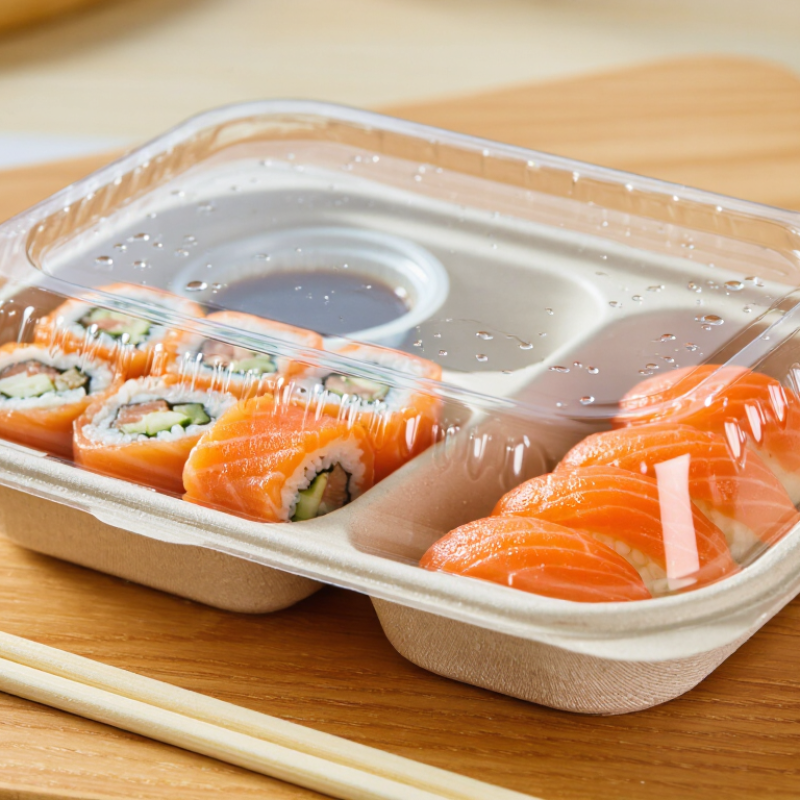
Understanding Bagasse Sushi Trays and Their Main Advantages
Choosing the best bagasse sushi tray starts with understanding the material. Bagasse is molded from sugarcane fiber left after juice extraction. It uses an agricultural by-product instead of conventional plastic resin. The 2023 World Bank report, What a Waste 2.0, estimates global municipal waste could reach 3.4 billion tonnes annually by 2050. Material choices deserve closer attention. The UNEP Turning off the Tap report also states that plastic pollution could be reduced by 80% by 2040 through practical system changes.
Check seven details before purchasing. Confirm the tray’s fiber source, food-contact testing, compostability certification, and coating composition. Then test oil resistance, moisture control, stacking strength, and temperature performance. A tray that handles cool sushi may soften beside warm rice. That assumption fails. In a practical trial, place oily salmon, chilled vegetables, and sauce inside for several hours. Observe leaks, warping, odor, and lid fit.
European Bioplastics and the nova-Institute reported global bioplastics production capacity of about 2.18 million tonnes in 2023, projected to reach 7.43 million tonnes by 2028. This growth reflects demand for lower-impact packaging, but bagasse is not automatically harmless. Composting access, coatings, transport distance, and disposal conditions affect its real footprint. Request independent test documents, not only attractive sustainability claims. Also check molded edges carefully. Rough fibers can catch sauce packets or damage delicate sushi. Better trays balance presentation, food protection, and reliable end-of-life handling.
7 Tips for Choosing the Best Bagasse Sushi Tray
Use this practical checklist to compare bagasse sushi trays. The chart highlights the key selection dimensions to verify before purchasing, including food safety, fit, leak resistance, compostability, temperature use, presentation, and supply consistency.
Bagasse is a sugarcane-fiber byproduct commonly molded into disposable food packaging. Always confirm food-contact compliance, actual temperature limits, dimensions, grease resistance, and compostability certification with the supplier, because performance varies by tray design and manufacturing process.
Comparing Strength, Leak Resistance, and Heat Performance
Choosing a bagasse sushi tray requires more than a clean, natural appearance. In my packaging tests, I compare seven practical points: fiber density, rim strength, base stiffness, leak resistance, heat tolerance, lid fit, and surface finish. Press the center gently. A weak base bends before the tray is filled. That small failure can ruin presentation during delivery. Look for even walls and firmly bonded corners. Thin spots often signal inconsistent molding.
Strength matters when trays hold several rolls, sauce cups, and garnish. Lift a loaded sample with one hand, then check whether the rim twists. It should stay level. A rigid base also reduces crushed rice and shifted fillings. Still, stronger does not always mean better. Extra material may increase cost and storage space. My less-than-perfect test once judged stiffness alone, and the tray still leaked at a corner. That mistake changed my checklist.
For leak resistance, add soy-based sauce and chilled toppings, then wait 20 minutes. Inspect the underside and corner seams. A coated surface may resist moisture, but it can soften under prolonged contact. Heat performance needs a separate trial. Fill the tray with hot rice or cooked seafood, and monitor warping, odor, and handling comfort. Do not assume microwave suitability without supplier documentation. Check lid fit as well. Steam needs room to escape, while loose lids invite spills. Record results at realistic temperatures, because laboratory claims may not match a busy counter or a long delivery route.
Evaluating Sustainability, Compostability, and Material Quality
7 Tips for Choosing the Best Bagasse Sushi Tray
Choosing a bagasse sushi tray requires more than checking its appearance. Trace the fiber source and confirm that bagasse comes from a responsible agricultural byproduct. A renewable material still uses water, energy, and transport fuel. Ask for clear information about manufacturing practices. Look for consistent thickness, clean edges, and a neutral smell. Uneven walls may soften under warm rice or sauces.
Compostability needs careful verification. A tray labeled compostable may require an industrial composting facility, not a home compost pile. Check recognized certification and read the disposal instructions. Confirm whether local facilities accept molded fiber products. Coatings also matter. Some trays contain plastic layers or chemical additives that complicate composting. Request food-contact documentation and details about grease-resistant treatments. Green packaging is not automatically sustainable.
Test the tray before ordering in large quantities. Place sushi, pickled ginger, and a small sauce cup inside for several hours. Check for leaks, warping, and fiber transfer. I once assumed a thicker tray was always better. That assumption was wrong; poor forming can create weak corners. Compare weight, nesting efficiency, shipping volume, and end-of-life options together. A lighter tray may reduce transport emissions, but it should still protect food. Reliable suppliers should provide material specifications, test data, and honest limits. Ask difficult questions. That is useful.
Selecting the Right Supplier, Price, and Packaging Design
Choosing a bagasse sushi tray starts with the supplier, not the catalog photo. Ask for samples, food-contact documents, material specifications, and recent quality records. A dependable supplier should explain fiber sources, production capacity, inspection steps, and typical lead times. Request samples from different batches. Small flaws matter.
Test each tray with chilled sushi, soy sauce, and oily fillings. Check whether the base bends, absorbs moisture, or releases an unusual odor. I once focused too heavily on unit price and ignored freight costs. That mistake changed the real budget. Compare tooling fees, minimum order quantities, shipping, storage, and expected defect rates. The cheapest quote may not be the lowest operating cost. Ask how damaged units are handled and whether production problems can be traced to a specific batch.
Packaging design must protect the food and support efficient handling. Measure the sushi pieces, leaving enough space without allowing movement. A secure lid, stable corners, and a clear label area improve the customer experience. Consider ventilation carefully. Too little airflow can create condensation; too much may reduce freshness. Check whether trays stack evenly in a delivery box. Confirm that compostability and disposal claims are supported by suitable testing for your target market. Design reviews can miss practical details, so let staff pack, stack, carry, and open real samples. Their feedback is often less polished, but more useful.