
China Best U100 Dried Cherry 85g Dried Fruit Supplier?
Choosing a reliable supplier for u100 dried cherry 85g dried fruit requires more than comparing online prices. It requires careful attention to fruit quality, processing controls, packaging, and delivery consistency. In China’s dried fruit market, suppliers may offer different cherry varieties, sweetness levels, moisture ranges, and packing methods. A professional buyer should request product specifications, recent batch samples, ingredient details, and clear shelf-life information. The 85g format also deserves attention. It should feel practical for retail shelves, travel use, and controlled portioning.
Quality begins with the fruit.
Experienced suppliers should explain sourcing regions, sorting procedures, drying temperatures, and foreign-material controls. Buyers can inspect the cherries for even color, flexible texture, clean aroma, and minimal stem pieces. Laboratory reports may confirm moisture, microbiological safety, additives, and allergen information. However, one report cannot represent every shipment. Batch-based testing and traceability are more dependable. Packaging should protect the product from humidity, light, and crushing during transport. A sealed pouch with a readable label is helpful, but printing quality alone proves little.
This guide will examine how to compare China-based suppliers and verify their claims. It will consider factory experience, export documentation, private-label capability, minimum order quantities, and communication speed. A lower quotation may seem attractive, yet it can reflect weaker packaging or inconsistent fruit grades. That possibility deserves honest review. Supplier rankings should remain evidence-based, not promotional. Samples, audits, and written specifications offer stronger confidence than polished photographs. No supplier should be approved without practical verification. Quality sometimes looks simple, but the details matter.
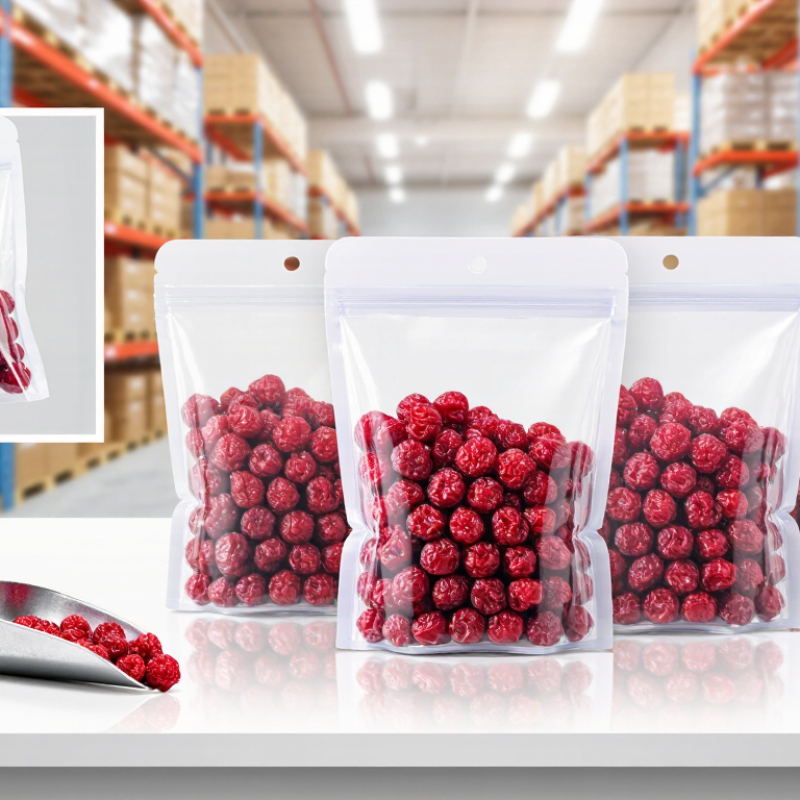
What Is U100 Dried Cherry in an 85g Retail Pack?
U100 dried cherry usually describes fruit size, not quality or nutrition. In many trade specifications, U100 means fewer than 100 dried cherries per pound. That equals an average piece weight above about 4.54 grams. The 85g retail pack may therefore contain roughly 18 to 25 pieces, depending on moisture, shape, and processing. It is not an exact piece-count promise.
The pack weight is 85 grams, or about three ounces. A USDA FoodData Central entry for sweetened dried cherries reports approximately 333 calories and 67 grams of total sugars per 100 grams. An 85g serving could provide about 283 calories and 57 grams of sugar. Values change with added sugar and drying methods. Check the nutrition panel carefully.
U100 does not automatically mean healthier, cleaner, or better tasting. I would avoid treating size alone as proof of quality. That assumption is convenient, but incomplete.
Tips:
Look for net weight, ingredient order, moisture information, and harvest or packing details. Press the pack gently. Fruit should feel pliable, not wet or rock-hard. Ask the supplier whether U100 is measured before or after final drying. This small detail can affect consistency. USDA grading references and FoodData Central are useful, but supplier specifications still need verification. Expect some variation.
How China Produces and Processes Dried Cherries
China Best U100 Dried Cherry 85g Dried Fruit Supplier?
How China Produces and Processes Dried Cherries
China’s dried cherry processing starts with maturity checks, not the dryer. Workers inspect color, firmness, sugar level, and visible damage. Refractometers help measure soluble solids before washing and pitting. The fruit then moves through controlled hot-air drying, often at moderate temperatures. Exact settings vary with cherry size, moisture, and final texture. This step needs patience.
Many Chinese processors use stainless-steel washing lines, optical sorting, and calibrated metal detectors. Some formulations include permitted sweeteners or preservatives. Others rely on drying and sealed packaging alone. FAO’s State of Food and Agriculture reports that 13% of food is lost between harvest and retail. Drying can extend usability, but it cannot repair poor fruit quality.
USDA FoodData Central lists dried sweet cherries at about 325 calories per 100 grams. An 85-gram pouch therefore provides approximately 276 calories, before recipe differences. The INC Global Statistical Review 2023 also identifies China as an important dried-fruit production and consumption market. A reliable supplier should provide moisture, water activity, microbiological, and residue test results. Packaging should limit oxygen and humidity. In practice, water activity control remains a weak point. A product may look dry, yet soften during storage. That detail deserves more testing, not optimistic wording.
Key Quality Standards for U100 Dried Cherries
China Best U100 Dried Cherry 85g Dried Fruit Supplier?
U100 dried cherries are generally understood as large fruit, with fewer than 100 pieces per pound. However, this grading term can vary between suppliers. Define the counting method in the purchase specification. An 85g pack should show consistent fruit size, clean cutting, and minimal broken pieces. Size is only one signal. Color can mislead. Bright red fruit may contain added color, while natural fruit can appear darker.
Reliable quality control begins with moisture testing. Excess moisture may create a sticky texture, mold risk, or shorter shelf life. Very dry cherries can become hard and lose their pleasant chew. Request the agreed moisture range, ingredient declaration, and batch test report. The report should cover microbiological safety, heavy metals, pesticide residues, and foreign-material control. Traceability should connect each pack with its processing date and raw-material lot.
Packaging needs equal attention. An 85g retail pouch should protect the fruit from oxygen, humidity, and light. Check seal strength, net weight accuracy, and transport performance. Taste samples at room temperature, not directly after opening a cold carton. Texture often changes after several hours. This step is easy to overlook. A careful supplier should explain whether cherries are sweetened, infused, or treated with preservatives. Requirements may differ by market, so confirm current destination rules with qualified compliance staff. U100 alone does not prove premium quality. Fresh samples, documented controls, and repeatable batches provide stronger evidence.
How to Evaluate an 85g Dried Fruit Supplier in China
China Best U100 Dried Cherry 85g Dried Fruit Supplier?
Choosing an 85g dried fruit supplier in China requires more than comparing prices. Ask how the supplier defines U100, because grading terms can differ between factories. Request a recent product specification, including cherry size, moisture, water activity, color, sugar content, and preservative use. A reliable supplier should explain each figure clearly.
Request samples from the same production line used for bulk orders. Check the pouch seal, label accuracy, cherry texture, and weight after opening. The fruit should feel flexible, not wet or unusually hard. Ask for batch records, ingredient statements, laboratory reports, and traceability documents. Food safety systems, factory audits, and export experience offer useful evidence, but certificates alone are not enough.
Look closely at the 85g packaging process. Confirm net weight tolerance, material safety, carton strength, coding, and storage conditions. Ask whether the supplier can maintain consistent supply during seasonal changes. Small test orders may reveal weak communication or unstable packing quality. That matters. I would also compare three samples under the same conditions, although personal taste can distort the result. A careful evaluation should include response time, complaint handling, production lead time, minimum order quantity, and the supplier’s willingness to disclose limitations. Sometimes the cheapest quotation hides higher inspection or replacement costs.
Packaging, Storage, and Export Considerations for Dried Cherries
For a China-made U100 dried cherry pack, the 85 g format needs more than an attractive pouch. It needs a measurable barrier against moisture and oxygen. The packaging should use food-contact materials with strong moisture resistance, secure heat seals, and clear lot coding. A practical certificate of analysis should record water activity, moisture, microbiological results, pesticide residues, and foreign-material checks.
The FDA Food Code identifies 0.85 water activity as an important control point for pathogen growth. Many shelf-stable dried fruit programs target below 0.60, but the exact limit must match the recipe and process. The USDA FoodData Central database lists dried sweet cherries at roughly 325 calories per 100 g, with about 10 g of fiber. Added sugar can change that profile. Buyers should verify the actual batch, not trust a standard catalogue value.
Storage should remain cool, dry, shaded, and away from strong odors. FAO’s State of Food and Agriculture 2019 estimated that 14% of food is lost between harvest and retail. Poor pallet ventilation can make that figure feel very real. For export, use strong cartons, corner protection, and moisture-resistant liners. Desiccants or oxygen absorbers may help, but only after validation. A perfect-looking pouch can still hide soft fruit, condensation, or seal weakness. I would request retained samples after transport simulation, because laboratory results alone do not reproduce every shipping mistake. Destination labeling, allergen declarations, certificates, and import documents must be checked against the receiving market’s current requirements.
China Best U100 Dried Cherry 85g Dried Fruit Supplier? - Packaging, Storage, and Export Considerations for Dried Cherries
| Category | Parameter | Typical Commercial Specification | Packaging, Storage, or Export Consideration |
|---|---|---|---|
| Product Grading | U100 size grade | “U100” commonly indicates fewer than 100 dried cherry pieces per pound, meaning a relatively large fruit size. The exact count, tolerance, and counting method should be confirmed in the purchase specification. | Request a signed product specification and a representative pre-shipment sample because grading conventions may vary between suppliers and markets. |
| Retail Format | Net weight | 85 g The declared net weight should exclude the pouch, label, carton, and other packaging materials. | Use calibrated filling equipment and define the permitted average weight and individual pack weight tolerance in the contract. |
| Ingredient Profile | Formula and additives | Common formulations may contain dried cherries, sugar or fruit sweetener, and an acidity regulator. Sulfur dioxide or sulfites may be used in some products, but this depends on the formulation. | The ingredient list, allergen statement, additive declaration, and sulfite declaration must match the actual recipe and the destination-market regulations. |
| Quality Control | Appearance and defects | Typical requirements include uniform cherry color, a soft and chewy texture, absence of visible mold, infestation, foreign matter, abnormal fermentation, and unacceptable off-odors. | Define limits for broken pieces, stems, pits, darkened fruit, foreign material, and damaged packaging before production begins. |
| Moisture Management | Moisture and water activity | Commercial dried-fruit moisture often falls within an approximately 15%–20% range, but the correct value depends on the recipe and texture. A water-activity target of about 0.60–0.65 or lower is commonly used for improved shelf stability when compatible with the product texture. | Use a validated laboratory method and record both moisture and water activity. The final limits should be agreed with the buyer rather than assumed from the product name. |
| Primary Packaging | 85 g pouch or sachet | A heat-sealed flexible pouch made with a food-contact film is commonly used. PET/PE, BOPP/PE, or metallized laminate structures may be selected according to the required moisture, oxygen, and light barrier. | Confirm food-contact compliance for every packaging layer in the destination market. Check seal strength, leak resistance, print durability, and migration documentation. |
| Atmosphere Control | Oxygen and light protection | High-barrier film and, where appropriate, nitrogen flushing can help reduce oxidation, color changes, and quality loss. Oxygen absorbers should only be used after a packaging-safety assessment. | Validate residual oxygen, seal integrity, and package performance through shelf-life testing under the expected transport and storage conditions. |
| Outer Packaging | Cartons and palletization | Retail pouches are normally packed into corrugated export cartons with internal protection against crushing and moisture. Carton quantity, dimensions, gross weight, and pallet pattern depend on the buyer’s logistics plan. | Use a dry, clean, odor-free carton. Confirm carton markings, pallet dimensions, stretch-wrap requirements, and maximum stack height before loading. |
| Storage | Warehouse conditions | Store sealed packs in a cool, dry, clean, and well-ventilated area, protected from direct sunlight, heat, moisture, pests, and strong odors. Avoid contact with floors and exterior walls. | Use first-expired, first-out stock rotation. Keep the product away from chemicals and odor-releasing goods, and monitor temperature and relative humidity during storage. |
| Shelf Life | Best-before period | A sealed dried-cherry product may commonly be assigned approximately 9–12 months, and sometimes longer, depending on formulation, water activity, packaging barrier, and validated stability results. | Do not print a shelf-life period without supporting real-time or accelerated stability data and compliance with the importing country’s date-marking rules. |
| Food Safety | Testing and certificate of analysis | A batch COA may include moisture, water activity, microbiological results, sulfite level when applicable, pesticide-residue screening, heavy metals, and foreign-matter inspection. | The testing plan should reflect the destination country, raw-material risk assessment, customer requirements, and applicable food-safety management system. |
| Labeling | Retail label information | Common label elements include product name, ingredient list in descending order by weight, net quantity, nutrition information where required, lot code, best-before date, storage instructions, country of origin, and responsible food-business details. | Label language, nutrition format, allergen rules, additive names, date format, and origin wording must be checked against the destination-market legislation. |
| Traceability | Lot and production records | Each retail unit and export carton should be traceable to a production lot, ingredient records, packaging materials, processing date, and quality-control results. | Maintain a documented recall procedure and ensure the lot code remains legible throughout transport, storage, and retail handling. |
| Customs Classification | HS-code reference | Dried cherries are generally classified under the dried-fruit heading, commonly HS 0813.40 for “other fruit, dried,” subject to the exact national tariff schedule and product formulation. | Confirm the final tariff code with the importer or customs broker because national subdivisions, sweetening, preparation, and packaging may affect classification. |
| Export Documents | Core shipping documents | A typical export file may include a commercial invoice, packing list, transport document, certificate of origin when required, product specification, COA, and insurance documents where applicable. | A phytosanitary certificate, health certificate, import permit, or additional declaration may be required by the destination country and should be confirmed before shipment. |
| Transport | Container and loading conditions | Use a clean, dry, odor-free container with intact flooring and walls. Protect cartons from condensation, rain, prolonged heat, and direct sunlight during loading and transit. | For long-distance shipments, review temperature and humidity exposure, desiccant requirements, container ventilation, and cargo-insurance conditions with the logistics provider. |
