
NACL Industries Limited

China Top Circuit Board Material Suppliers?

China has become a major sourcing destination for advanced Circuit Board Material, serving consumer electronics, automotive systems, telecommunications, and industrial equipment. Its supplier base includes manufacturers of FR-4 laminates, high-Tg materials, low-loss materials, flexible substrates, copper-clad laminates, and specialty dielectric sheets.

Selecting a supplier requires more than comparing prices. A practical review should examine dielectric constant, dissipation factor, glass-transition temperature, thermal expansion, copper adhesion, moisture resistance, and CAF performance. Factory audits also matter. Look for laboratory capability, stable batch records, ISO certification, IPC compliance, and clear traceability from resin mixing to final packaging. Small details reveal reliability. A sealed moisture barrier bag can protect material during long transport. A missing test report cannot.

John Coonrod, a long-time Rogers Corporation technical expert, has stressed, “Material choice is a system decision, not simply a catalog decision.” This view is especially useful when evaluating China-based suppliers. A low-cost laminate may perform well in a prototype, yet fail during reflow cycling or high-frequency testing. That risk is easy to underestimate.

This guide examines leading Chinese Circuit Board Material suppliers through technical capability, product range, quality control, delivery performance, and export experience. It also considers an uncomfortable point: supplier rankings are never permanent. Equipment changes, resin formulations evolve, and one strong production line does not guarantee every batch. Buyers should verify current data, request samples, and test materials under real operating conditions before approving large orders.
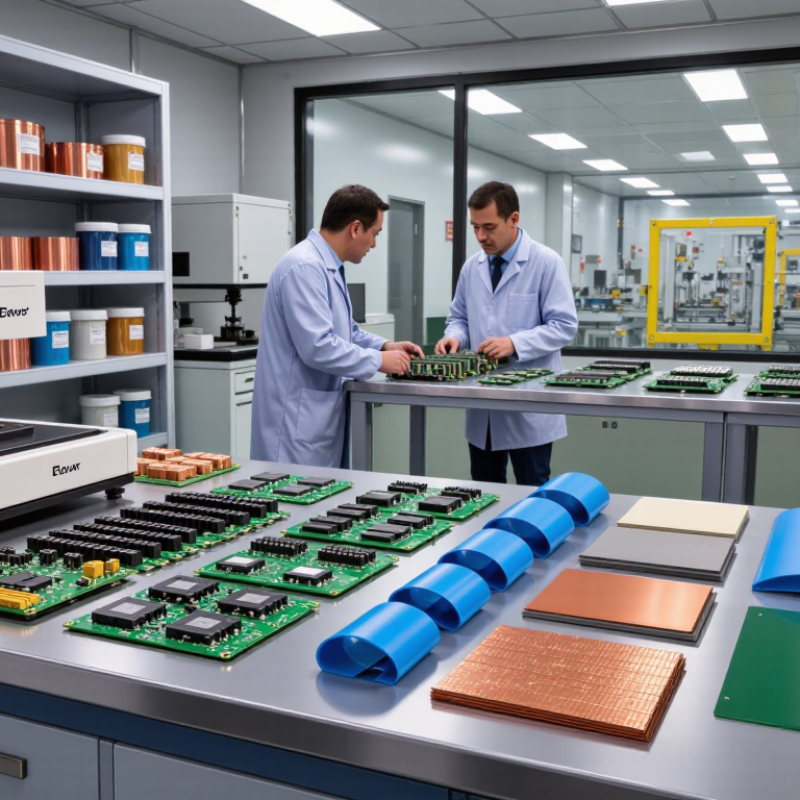
China Top Circuit Board Material Suppliers?

What Circuit Board Materials Are and Why They Matter

Circuit board materials form the physical and electrical foundation of every printed circuit board. They include copper foil, laminate, resin, solder mask, and surface finishes. Each layer controls conductivity, heat movement, mechanical strength, or long-term protection. A material choice is never just a purchasing detail. It affects signal quality, assembly yield, service life, and total cost. In China’s manufacturing market, suppliers often provide standard and specialized grades for varied applications. Availability alone does not prove reliability.

Engineers usually begin with operating conditions, not a catalog price. A high-frequency design may need low-loss laminate and tightly controlled dielectric thickness. Power equipment may require stronger thermal performance and stable insulation. Flexible products need materials that tolerate repeated bending without cracking copper traces. Humidity, temperature cycling, and chemical exposure also deserve practical testing. A datasheet helps, but sample verification reveals more. Measure dimensional stability, peel strength, dielectric properties, and thermal resistance under realistic conditions. Small process differences can change results.

Reliable sourcing depends on traceable specifications, consistent batches, and clear technical communication. Ask for test reports, change-control procedures, and application support before approving a supplier. Factory audits can expose storage problems, poor moisture control, or weak inspection routines. A practical lesson from production reviews is simple: attractive samples may fail after uncontrolled processing. That makes qualification slower, but usually wiser. No material is perfect for every board. Cost pressure can tempt teams to accept compromises they cannot explain later.

Key Material Types Used in China’s Circuit Board Industry

China Top Circuit Board Material Suppliers?

Key Material Types Used in China’s Circuit Board Industry

Circuit board production in China relies on several carefully matched material groups. Copper-clad laminate remains the structural base for most rigid printed circuit boards. It combines copper foil with woven glass fabric and an epoxy resin system. Standard FR-4 supports general electronics, while high-Tg grades withstand greater heat during assembly.

Prepreg bonds multilayer boards under controlled pressure and temperature. Its resin content affects layer spacing, flow, and final thickness. High-frequency designs may use low-loss resin systems, ceramic-filled materials, or PTFE-based laminates. These options help control signal loss and dielectric variation. They also demand tighter processing conditions. Small errors matter.

Flexible circuits commonly use polyimide films with rolled copper foil. The material must tolerate repeated bending without cracking or delamination. Solder mask protects exposed circuitry and improves insulation. Dry film photoresist supports precise image transfer during circuit formation. Surface finishes, including immersion coatings and plated metals, protect copper from oxidation and improve solderability.

Experienced buyers should compare datasheets with actual production results. Key checks include glass transition temperature, thermal expansion, dielectric properties, peel strength, and moisture resistance. Samples can pass laboratory tests yet behave differently on a high-volume line. That gap deserves attention. Material selection is not perfectly predictable, especially when press cycles, storage conditions, and board thickness change. Reliable suppliers therefore provide traceable test reports, stable specifications, and technical support during qualification.

Leading China-Based Suppliers and Their Product Strengths

China-based circuit board material suppliers cover a broad range of applications, from consumer electronics to automotive control units. Prismark’s 2023 industry review valued the global PCB market at roughly US$69 billion. This scale supports strong local production capacity, especially for copper-clad laminates, prepregs, and specialty dielectric materials.

Standard FR-4 remains the practical strength of many Chinese suppliers. Common offerings include 18 μm and 35 μm copper foil, halogen-free grades, and high-Tg laminates above 150°C. These materials suit multilayer boards, power modules, and lead-free assembly. Some manufacturers also provide low-loss laminates for high-speed signals, with carefully controlled dielectric constant and dissipation factor. IPC’s 2024 market outlook continues to identify data infrastructure, automotive electronics, and advanced computing as major demand drivers.

Quality differences still matter. A lower Df value on a datasheet does not guarantee better field performance. Resin distribution, copper roughness, thermal cycling, and batch consistency can change results. I have seen specifications look excellent, yet process engineers needed extra press-cycle validation. That is the uncomfortable part. Buyers should request traceable test reports, RoHS and REACH documentation, CAF resistance data, and samples tested under actual humidity and temperature conditions. Price is useful, but it is not proof of reliability.

China Top Circuit Board Material Suppliers? - Leading China-Based Suppliers and Their Product Strengths

A product-focused comparison of major material categories supplied from China for rigid, flexible, high-frequency, and high-reliability printed circuit board manufacturing.

Supplier Profile Primary Material Category Key Product Strengths Typical Technical Characteristics Common PCB Applications Common Qualification and Compliance Focus
Profile A
High-volume laminate producer
FR-4 copper-clad laminate Stable supply for standard multilayer boards, broad thickness availability, consistent resin content, and cost-effective production for high-volume orders. Glass-reinforced epoxy construction; standard Tg commonly around 130–150°C; available in halogen-free and lead-free-process-compatible grades. Consumer electronics, industrial controls, power supplies, LED boards, networking equipment, and general multilayer PCBs. UL flammability requirements, RoHS and REACH substance controls, IPC material evaluation, dimensional stability, and soldering reliability.
Profile B
High-Tg laminate specialist
High-Tg and lead-free FR-4 Improved thermal endurance, better resistance to repeated lead-free reflow exposure, controlled expansion, and enhanced reliability for multilayer constructions. Tg commonly above 170°C for premium grades; lower Z-axis expansion than standard FR-4; suitable for higher thermal-cycle requirements. Automotive electronics, servers, industrial automation, telecom equipment, high-layer-count boards, and lead-free assembly. UL recognition, IPC-4101 material requirements, RoHS and REACH compliance, CAF resistance testing, thermal stress, and reliability qualification.
Profile C
Halogen-free material producer
Halogen-free copper-clad laminate Reduced halogen content, low-smoke positioning, compatibility with lead-free soldering, and a portfolio designed for environmentally focused product programs. Phosphorus- or nitrogen-based flame-retardant systems; commonly available in standard and high-Tg grades; designed to meet applicable halogen limits. Consumer products, data infrastructure, office equipment, green-energy systems, and electronics requiring restricted-substance documentation. RoHS, REACH, halogen-content declarations, UL flammability performance, material traceability, and customer environmental documentation.
Profile D
High-frequency material supplier
Low-loss and high-frequency laminates Controlled dielectric performance, low dissipation factor, low moisture absorption, tight dielectric-thickness control, and support for high-speed signal integrity. PTFE-based, hydrocarbon-ceramic, or modified-resin systems; low Dk and low Df grades available; values depend on frequency, resin content, and test method. 5G infrastructure, antennas, radar modules, satellite communications, automotive radar, RF power amplifiers, and high-speed backplanes. IPC-4103 or application-specific specifications, dielectric testing at target frequencies, dimensional stability, peel strength, and process compatibility.
Profile E
Metal-core PCB material supplier
Aluminum and copper metal-core laminates Efficient heat spreading, stable dielectric insulation, support for high-power LED and power-electronics designs, and availability of different thermal-conductivity levels. Aluminum or copper base plate with thermally conductive dielectric layer; thermal conductivity commonly ranges from approximately 1 to above 8 W/m·K depending on grade. LED lighting, motor drives, power converters, automotive lighting, battery systems, and high-current control modules. Thermal resistance testing, dielectric breakdown, peel strength, dimensional stability, UL requirements, and thermal-cycle reliability.
Profile F
Flexible circuit material supplier
Flexible copper-clad laminate Thin and bendable constructions, good flex-fatigue performance, controlled dimensional change, and compatibility with roll-to-roll or sheet-based flexible-circuit processing. Polyimide-based constructions are common; copper may be rolled-annealed or electrodeposited; thin dielectric and copper options support dynamic or static flex designs. Display modules, cameras, wearable electronics, medical devices, automotive sensors, printers, and compact interconnect assemblies. Flexibility and bend testing, dimensional stability, soldering resistance, UL requirements, RoHS and REACH controls, and coverlay or adhesive compatibility.
Profile G
High-reliability material supplier
Automotive and industrial reliability laminates Improved CAF resistance, low moisture absorption, stable electrical insulation, strong thermal-cycle performance, and tighter process-control documentation. High-Tg or mid-loss resin systems; controlled Z-axis expansion; grades selected for vibration, humidity, thermal shock, and long service-life conditions. Engine-control electronics, advanced driver-assistance systems, industrial drives, energy storage, aerospace-related equipment, and safety-critical controls. Automotive quality systems, IPC qualification, CAF resistance, thermal shock, pressure-cooker testing, insulation resistance, and lot traceability.
Profile H
Specialty resin and prepreg supplier
Prepreg and resin systems Broad resin-content selection, controlled flow during lamination, support for sequential buildup, impedance-controlled multilayers, and customized dielectric thickness. Available in woven-glass styles with different resin contents; flow, gel time, cure profile, and dielectric properties are selected for the PCB lamination process. HDI boards, rigid-flex constructions, high-layer-count PCBs, high-speed computing, telecom systems, and fine-line interconnect designs. Resin-content uniformity, gel-time control, lamination compatibility, IPC material requirements, moisture management, and batch-level quality records.

Note: Technical values vary by material grade, copper thickness, resin content, glass style, test method, and production lot. Final selection should be confirmed through the supplier’s current datasheet and qualification report.

How to Compare Quality, Certifications, and Technical Support

China Top Circuit Board Material Suppliers? Compare Quality, Certifications, and Technical Support

Choosing a circuit board material supplier requires more than comparing prices. Review dielectric constant, dissipation factor, glass transition temperature, and thermal expansion data. Ask for recent test reports, lot traceability, and certificates covering each production site. Certifications such as ISO 9001, ISO 14001, IPC compliance, and relevant safety approvals can support confidence. However, a certificate alone may not prove consistent material performance.

Request samples from the same manufacturing line used for volume orders. Inspect copper adhesion, surface uniformity, thickness tolerance, and drill behavior. A reliable technical team should explain stack-up options, impedance control, soldering limits, and thermal concerns clearly. During evaluation, notice response speed and technical accuracy. Fast replies are useful, but incomplete answers create expensive delays. In practical sourcing work, I have learned that supplier data sometimes looks perfect until process variation appears.

Tips: Ask for a material datasheet, certificate of analysis, and sample inspection record. Compare test methods, not only reported values. Discuss storage conditions and shelf life. Keep one approved reference sample. Also, challenge unclear claims politely. No checklist is perfect. A small pilot order can reveal support quality, packaging problems, and performance differences before full production.

China Top Circuit Board Material Suppliers: How to Compare Quality, Certifications, and Technical Support

Use this neutral 100-point benchmark to compare PCB material suppliers without relying on company or brand rankings. The framework emphasizes manufacturing quality, recognized certifications, material compliance, and engineering support.

Quality consistency receives the highest weighting because stable dielectric properties, copper adhesion, dimensional control, and lot-to-lot performance directly affect PCB reliability. Certification and compliance cover ISO 9001, IATF 16949 where automotive qualification is required, ISO 14001, IPC-4101 material specifications, flammability classification, and RoHS/REACH documentation. Technical support includes stack-up guidance, material selection, datasheet accuracy, failure analysis, and response capability.

Choosing the Right Chinese Supplier for Your PCB Application

Choosing the right Chinese PCB material supplier starts with your application, not a catalog. A 2024 Prismark PCB Industry Forecast placed global PCB sales near US$75 billion, showing how quickly material requirements are diversifying. High-speed boards need stable dielectric performance. Power boards need stronger thermal endurance. Flexible circuits require controlled bend reliability.

Request a complete technical data sheet. Check glass-transition temperature, dielectric constant, dissipation factor, Z-axis expansion, copper peel strength, and moisture absorption. For lead-free assembly, ask for thermal stress results after multiple reflow cycles. IPC-4101 and IEC 61189 provide useful reference points for laminate specifications and test methods. Do not accept “high quality” as technical evidence.

Ask for three recent batch reports, not one perfect sample. Verify resin content, copper thickness, lot traceability, and storage conditions. An on-site audit should examine humidity control, pressing records, laboratory calibration, and nonconformance handling. A supplier can look excellent on paper and still fail a humidity test.

Small details matter. Send the actual stack-up, operating temperature, signal frequency, and expected volume. Then request prototype panels before mass production. Price matters, but a cheaper laminate may create drilling defects, delamination, or impedance variation. Some supplier claims remain difficult to verify. That is where independent testing becomes worthwhile, especially for automotive, medical, and high-frequency applications.

Article Source:

Contact Us

Reach out to our dealer network